
Maybe I'll Make You Laugh #9
Stages of Genocide in a Country of Genocide, Charlotte Cornfield, Aldous Harding

On this Substack, I share stories about my life and discuss two things I enjoy, along with the occasional thing I dislike, in the realms of media, music, literature, and film. (Surprise to nobody who knows me: it’s usually music). Today’s a little different but mostly the same.
I haven’t written in months, and it feels corny and Bridgerton-esque to assume anyone, a “gentle reader’, has noticed, but here I am. I have been really busy with mostly good things. I am still filming and fundraising for Fixin’ to Stay. I work my paid job, and have been doing some volunteer work for a mayoral candidate in NC. I see my sister and the kids more. I’ve been seeing some good shows, recently I saw Cat Power, Wednesday, and Built to Spill (all separate bills). While also, not so positively, I’ve also had a few health issues, and also positively, it has led me to biweekly acupuncture sessions, which have been really helpful.
Story of the Post
1. Stages of Genocide in a Country of Genocide- but White Trans Fear Is Not the Same Thing as Genocide
We live in a genocidal country and culture. The steps are always around us.
At five or six years old, I did not have the language for being transgender, but I did have the confidence of a small, poor kid who fully believed he should be playing baseball with the boys and fist-fighting boys in the gravel afterward. I was the only kid in the league who wasn’t born male, which apparently made me both a diversity initiative and a threat to the egos of both boys and their fathers. Games weren’t as stressful, but practice often turned into some kind of psychological warfare experiment where boys would quiz me on sports trivia like I was trying to enter the CIA instead of Little League. My dad told me I had a target on my back as “the only girl,” and told him he was insane. That I was a boy, and when he told me I wasn’t, I told him I was at very least half boy, if not most.
My mother is harder to explain because she both broke my heart and let me become myself before anyone had words for it. She fought for me to play in the all-boys league, let me dress however I wanted, supported my toughness, my foul mouth, my habit of coming home covered in dirt like a raccoon that had lost a bar fight. She also subscribed to deeply patriarchal ideas and had her own complicated relationship to womanhood, which meant I somehow grew up in the confusing emotional space of “gender freedom, but men know best, and you need their affirmation to survive.” Still, until I was around thirteen, I had this strange little pocket of freedom around her.
Unsurprisingly, my father’s reaction to me trying to explain that I was a boy did not exactly speed up my gender journey. Instead, I spent years confused, and when I finally came out in my twenties, I entered the grand American tradition of being trans in public: getting fetishized by strangers, yelled at on dating apps, called “it” by customers while carrying creme brulee to table twelve, and treated like everyone else’s personal sociology debate topic. These are some of the hard parts of being trans, though those hardships deepen depending on who you are, what you look like, how much money you have, and whether the world already viewed you as disposable before you transitioned.
Some trans people experience compounded disparities: being trans, being femme, not passing, being a person of color, not living in the United States, living in a state with anti-trans legislation, surgery being wildly expensive, losing relationships when you come out, having a disability, being low income, houseless, justice system impacted, etc.
While whiteness and class background don’t take away from the challenges of being trans in an anti trans world, they do allow some trans people more freedoms. This isn’t saying being cis isn’t infinitely easier in this world: it is in every possible way!
What I am trying to explain, especially to white trans people, is that we live inside systems and institutions that were already built through genocide, racial violence, colonization, and exclusion. The United States was founded through the genocide of Native people, shaped by the trans Atlantic slave trade and Jim Crow (both genocides), and continues to operate through deeply violent systems that disproportionately target poor people, disabled people, immigrants, and people of color, particularly Black people. I would go as far as to say that the AIDS crisis was genocidal, if not the exact definition of a genocide. Our healthcare system in the United States is genocidal. The United States funds and partakes in murder-genocides across the globe. We start wars. We bomb schools. We live in a genocidal country. So, I think when demonizing or oppressing people, these stages of genocide that everyone keeps mentioning are used. They have been and are used across many, many parts of the US and abroad.
The United States was not suddenly transformed into a violent country when trans people became a political target. Violence, dispossession, surveillance, and dehumanization have always been foundational to this country, even if different groups experience those realities in different ways and to different degrees.
That does not mean trans people are not under attack. We are. The rhetoric is escalating. Policies are expanding and growing. The fear is real. But Trumpism, specifically, operates through propaganda, spectacle, fear, and the manufacturing of internal enemies. It thrives on convincing different groups that they are uniquely under siege while expanding systems that harm many people at once. ICE not only threatens trans people. Prisons not only dehumanize trans people. These institutions have always functioned through cruelty. ICE has long terrorized immigrant families, raided homes, detained children, and disappeared people into detention centers. Prisons have long treated incarcerated people as disposable, especially Black people, queer people, disabled people, and poor people. Trump’s recent 16-page counter-terrorism memo names organizations that are pro transgender and threatens that if any of these groups hurt Americans, the government “Will find you and kill you.” Trump is basically just reinvigorating COINTELPRO in an effort to maintain power. Trans people often experience intensified violence within these systems, but the systems themselves were already violent.
It’s this age-old violence that makes me uncomfortable when I see people, white trans people mostly, demand that we are in a genocide right now in the United States. And I do not think most white trans people are saying these things maliciously. I think many are reacting from genuine fear, grief, and exhaustion after years of being dismissed, mocked, politicized, and told their pain is not real. How many times do we have to see a pedophile lawmaker call trans people groomers or pedophiles? Cis people, who might consider themselves allies, often don’t fully undo the gender binary in themselves. We were raised in a white supremacist country, a class-based society, and a gender binary. So, anti-racist white people know they have to question their unconscious bias and racism all the time, and I think cis people or self-identified cis allies have to do the same check-in with gender, too. Gender and sex are not just something that disappear from you, particularly as we live under a patriarchy. It impacts how people see their own gender or sex and thefor how they see others, and they probably aren’t even aware of it.
I think many trans people are desperate for language strong enough to communicate how frightening this moment feels. They want cis people to care. But I also think there is a difference between acknowledging escalating authoritarian violence against trans people and acting as though we are the only people being targeted by an increasingly repressive state. This isn’t me saying I think we should dress up like frogs and go to a No Kings rally (…because that’ll stop ICE)(lol it won’t and it’s so dumb). I am saying we haven’t experienced a murder-genocide yet, but have experienced maybe some of the stages leading up to one. So, really, we are not alone in this, and understanding that should deepen our solidarity, not weaken it. We shouldn’t let influencers’ engagement farm and think that reposting is going to get us the freedom we deserve. Only organizing and community, and taking care of ourselves, will do that.
Music
Charlotte Cornfield- Hurts Like Hell
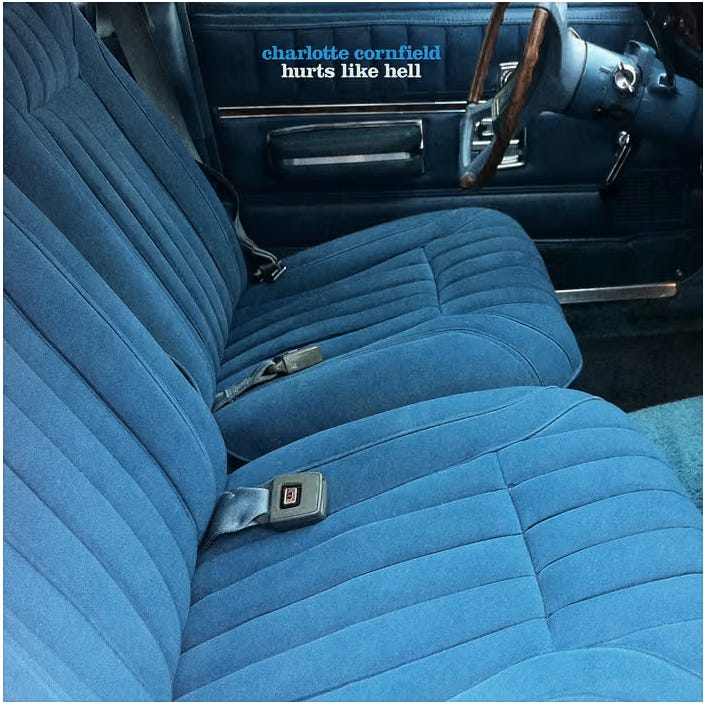
All hail Canadian indie rock.
Charlotte Cornfield, from Toronto, has stopped me in my tracks with her sixth album. I had heard some of her other music before this album, and I always “liked” her. In the way that she might show up on a playlist here and there, but the new album hits in a way I need right now. Hurts like Hell blends folk and country with vivid, diaristic storytelling about love, uncertainty, and new motherhood. Backed by collaborators like Feist, Buck Meek, and El Kempner (Palehound), the record feels intimate and grounded, full of sharply observed details that remain deeply relatable. Living With It is my favorite song on the album. It leans a bit more into rhythm, though it never loses the album’s restrained feel. The verses are sparse, mostly just strings and voice, before the chorus subtly expands with a muted bassline and a little synth. Feist’s vocals mumble alongside Cornfield’s less like a traditional harmony and more like an internal dialogue, shadowing her phrasing without fully marrying it. Together, their voices stretch and recede, circling the same emotions from slightly different angles.
Across all the songs about awkward parties, complicated relationships, pregnancy, and parenthood, Cornfield proves herself as one of the storytellers we need right now. Like Bill Callahan’s recent reflections on aging and selfhood, Hurts Like Hell stands out because Cornfield writes from the perspective of someone no longer trying to romanticize youth. As a mother, partner, and artist in her late thirties, she revisits love, confusion, and growing pains with both distance and hard-earned clarity, making the album feel all the more lived-in and resonant. With warm, sparse production and lyrics that are funny, tender, and painfully human, Hurts Like Hell shows listeners that life can still lead to that perfect album, or maybe it just shows aging millennials that, and that’s cool too.
Aldous Harding- Train on the Island
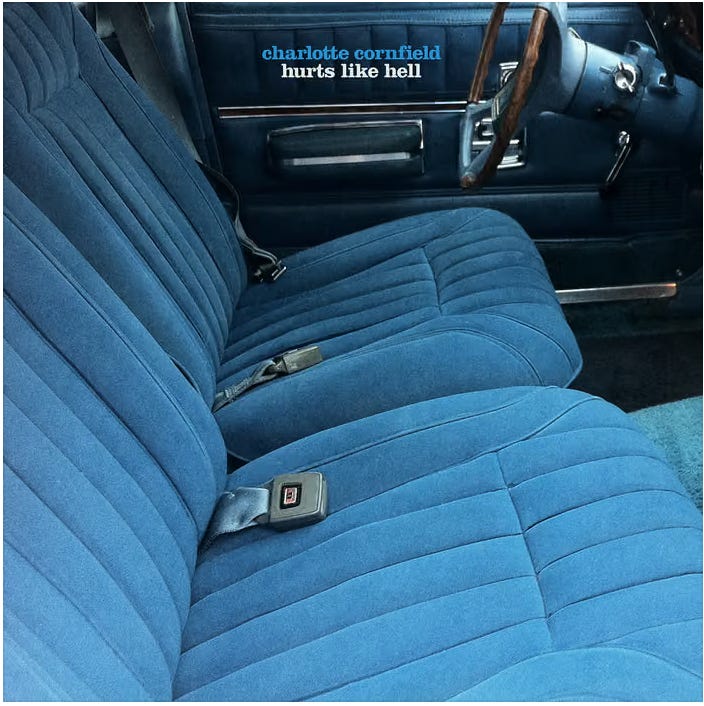
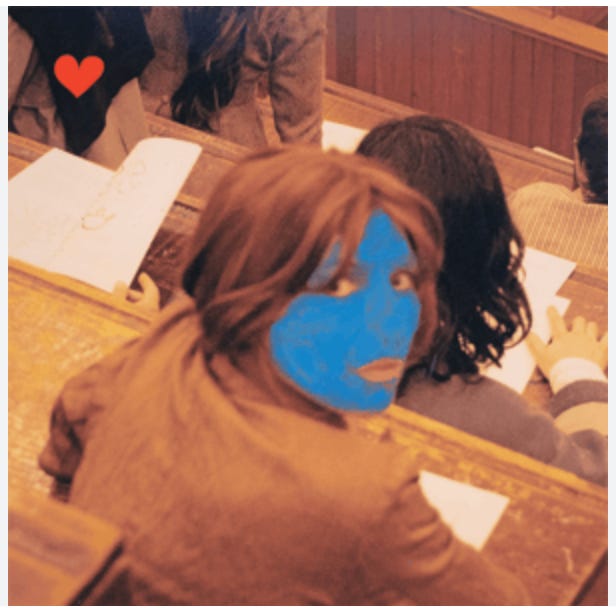
Aldous Harding is often framed as a kind of “weird girl” artist, in the same vein as how people once talked about Zooey Deschanel: quirky, eccentric, a little performative. But that whole archetype took a cultural hit after the backlash to that era of commodified “quirk,” and I’ve never fully understood why Harding ended up caught in that crossfire. St. Vincent dealt with something similar for years, until she made an album people deemed too undeniably good to dismiss. Not that any artist should have to prove themselves that way to be taken seriously.
I’ve always had a slightly forgetful relationship with Harding’s records. Every album has songs I really love, while the rest tend to hover somewhere nearby rather than fully land. Still, her oddness is what makes her compelling, especially within an indie landscape that, in the 2020s, can often feel flattened by sameness. She’s kind of mastered making interesting psychedelic folk for a 2026 ear.
Train On The Island continues Harding’s collaboration with John Parish, the English producer and songwriter, whose notably worked with PJ Harvey. Like PJ Harvey, Harding channels many parts of herself at once. On one song, she’s a spectral folk figure, all soft edges and drifting air; on another, she bends her voice into something jazzy and strange, almost instrumental.
Thankfully, Train On The Island doesn’t smooth out any of those eccentric edges and doesn’t have the room to. The album has only ten songs. The album remains deeply strange in the best sense: minimalist, emotionally exposed, and full of unpredictable turns that feel pulled straight from Harding’s singular inner world. It’s an album that drifts and blooms, loose and alive, like the feeling of spring arriving slowly. I think all of the characters Harding sings from causes distance for me; I’m not sure. I still only really love half of the album, but I’m still listening.